Blog /
Selling IWM puts with tastytrade mechanics: the first trade
A rules-based put-selling campaign on IWM: sell at 45 days out, take profit at 50%, manage at 21 days. The rules, the first trade, and where it stands three days in.
By Team Iron Wheel
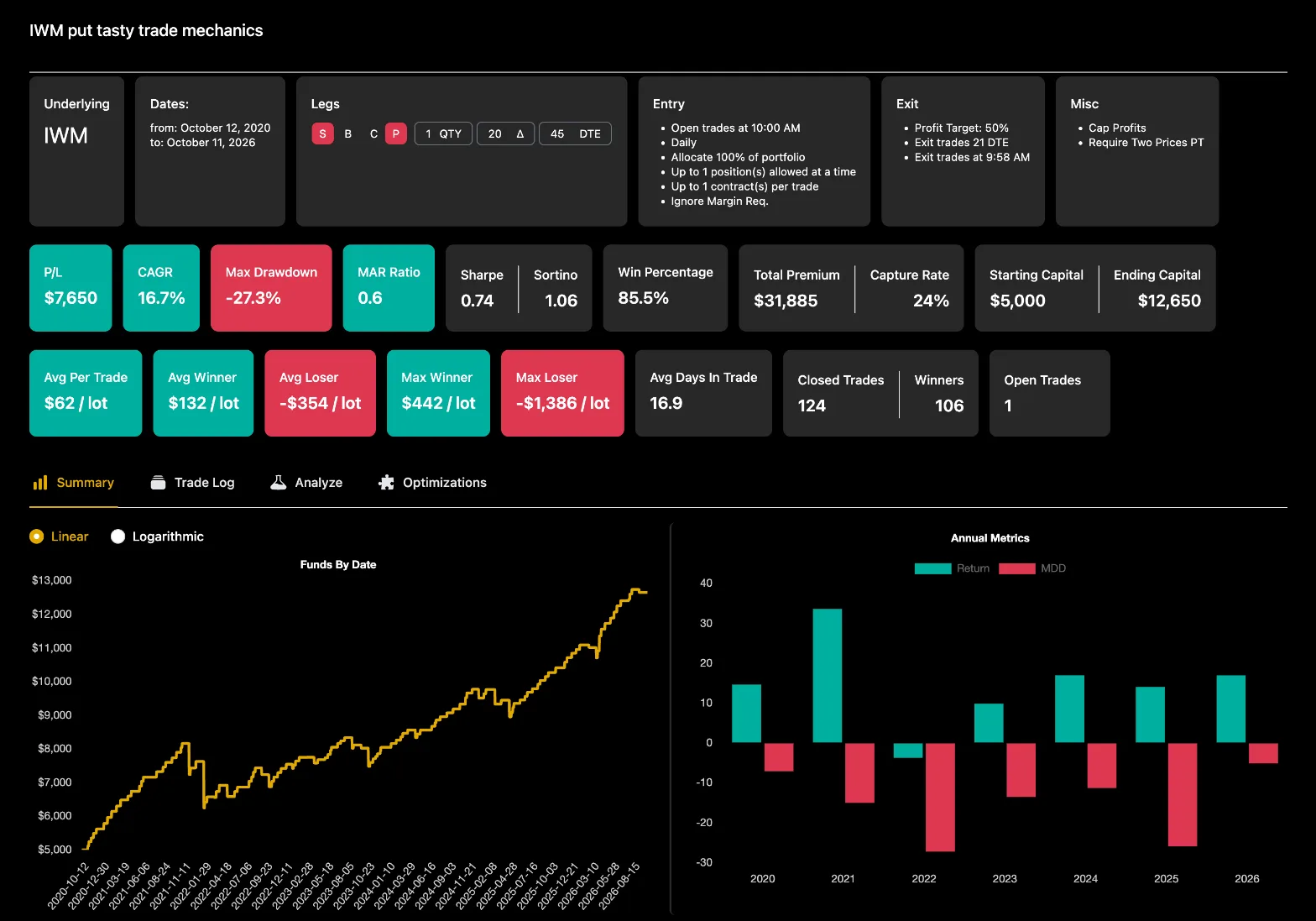
This post starts an example campaign that sells puts on IWM, the Russell 2000 ETF, by a fixed set of rules borrowed from tastytrade's approach to premium selling. Every trade goes into The Iron Wheel as it is made, and the posts in this series follow the campaign one trade at a time: what was done, which rule called for it, and where the position stands. It is an example for education, not a recommendation, and the risks get as much space below as the returns.
The rules
| Rule | Setting |
|---|---|
| Entry | Sell one put at about 20 delta, about 45 days to expiration |
| Profit target | Buy the put back once half the credit is captured |
| Management | At 21 days to expiration, close or roll whatever is still open |
| Size | One contract, one position at a time |
These are the short-premium mechanics tastytrade has popularized, and each rule has a reason behind it:
- 45 days out. Time decay is picking up by then, so the premium is worth collecting, while expiration is still far enough away for the trade to be wrong for a while without much damage.
- 20 delta. The strike sits well below the market. Delta is a rough stand-in for the chance of finishing in the money, so a 20-delta put is priced at very roughly one chance in five of ending up there.
- 50% profit. The second half of the premium is the slowest to arrive. Taking the first half and moving on frees the capital for the next trade sooner, and shortens the time the position is exposed.
- 21 days. Gamma, the rate at which delta changes as the price moves, grows as expiration approaches. Three weeks out, a modest drop in IWM can turn a comfortable position into a losing one within days, so the rules exit or roll rather than hold through the final weeks.
Trade #1
The first put was sold on October 12, 2026. It went into a new campaign (strategy: cash-secured put, underlying IWM), with the broker's fill entered on the Add Trade form:
| Detail | Value |
|---|---|
| Order | Sell 1 IWM Nov 27 2026 264 put |
| Days to expiration | 46 |
| Premium | $2.47 a share, $247 for the contract |
| Commission | $0.75 |
| Net credit | $246.25 |
| IWM at entry | $277.95 |
| Delta at entry | 0.21 |
| Break-even at expiration | $261.54 |
| Capital at entry (Reg-T margin) | $4,417 |
The break-even is the strike less the premium after commission: IWM could fall about 5.9% from the entry price before the put loses money at expiration. Below $261.54 the loss grows dollar for dollar with IWM, up to $26,154 if IWM went to zero. That is what cash-secured refers to: holding enough cash to buy 100 shares at $264 if the put is assigned.
A margin account holds less. Under Reg-T rules The Iron Wheel put this position's requirement at $4,417 at entry, about a sixth of the cash-secured amount. Margin changes how much capital is set aside, not how much the position can lose: the loss below $261.54 is the same either way. How the requirement is calculated, under Reg-T or TIMS, is covered in P/L, capital and break-even.
Three days in
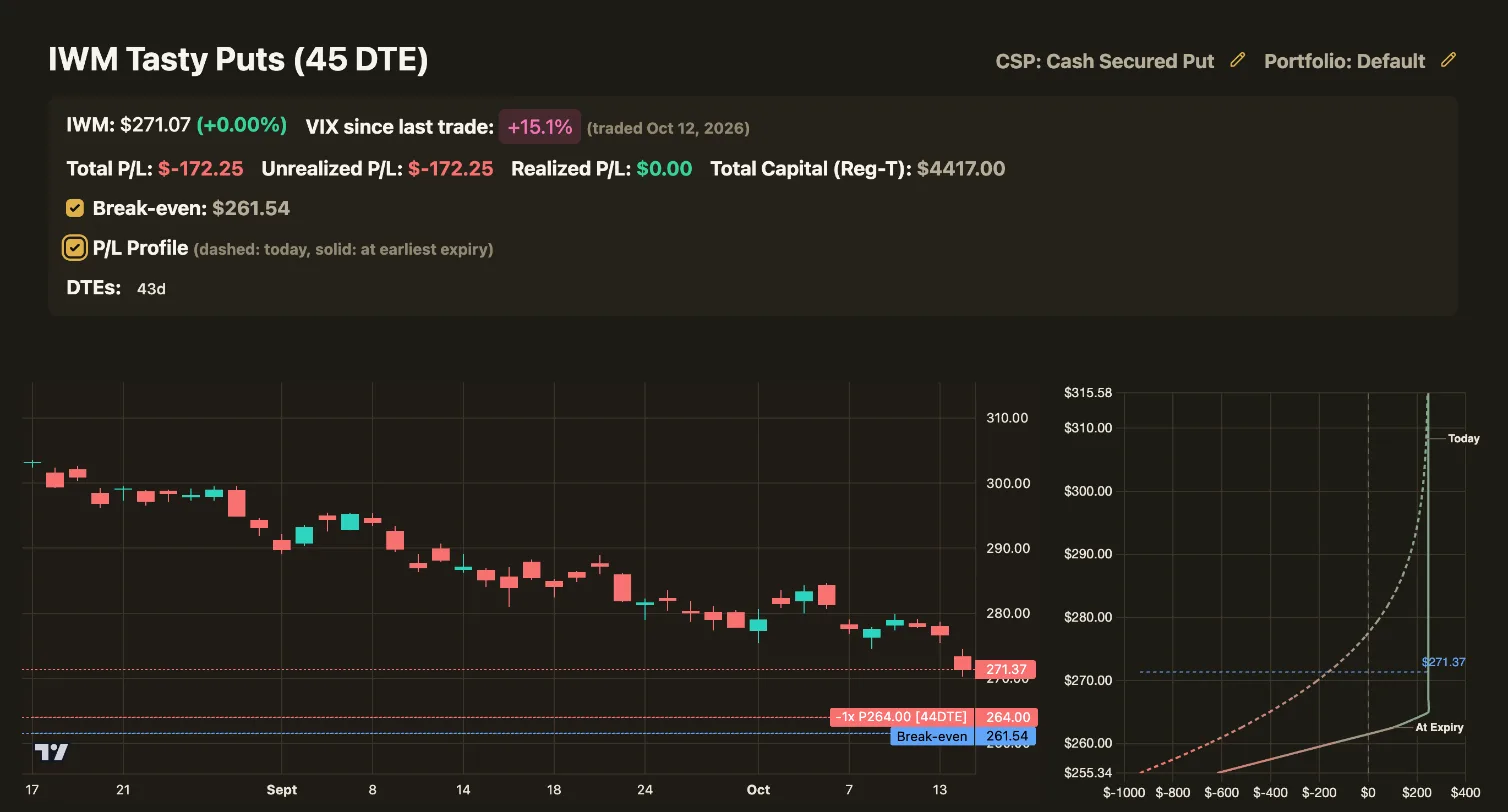
By the morning of October 15, IWM had fallen 2.5%, to $271.07, and VIX was up 15% since the trade. Both raise a put's price: this one is now marked at $4.19, against the $2.46 it was sold for net of commission, and the campaign shows an open loss of $172.25. Delta has risen from 0.21 to 0.32, so the position now gains or loses about as much as 32 shares of IWM would.

None of this triggers a rule. The profit target is a long way off, 21 days to expiration is three weeks away, and IWM is still 3.5% above the break-even. Under these rules an open loss is not on its own a reason to act: the exits are set in advance so that decisions are not made in the middle of a move. It is also a small, live example of the drawdowns in the backtest.
The plan from here
- Profit target. Buying the put back at about $1.24 keeps half the credit, roughly $123 before commission. A good-till-canceled (GTC) order at that price fills it without anyone watching the screen.
- November 6. The put reaches 21 days to expiration. If it is still open, it is closed, or rolled out to the expiration nearest 45 days.
- Assignment. If the put were held to November 27 and IWM finished below $264, it would be assigned: 100 shares bought at $264. That is the first half of the Wheel, and the campaign would carry on with the shares.
Whatever happens is recorded in the same campaign, so the realized P/L of each closed or rolled put, the break-even of the next one and the capital it ties up stay together on one page. The campaign page guide explains each of those numbers.
A review of this trade follows in a week, and more example campaigns will follow it.